

If you’re setting next year’s marketing budget, start with the last few customers who called, booked, or walked in. How did they find you? What did they need to know before taking the next step? Those answers can help you decide whether your next dollar should go toward getting found, making your website easier to use, or following up on the inquiries you already get.
That’s a more useful starting point than a percentage or whatever the business down the street is spending. This guide walks Flagstaff and Northern Arizona owners through a simple way to plan a small business marketing budget for 2027: pick one outcome, find where customers get stuck, match what you’re seeing to the right first move, and leave with a plan for Q1.
Pick one business outcome for 2027
A budget is easier to build when it’s working toward one clear result. Think about what would make the biggest difference to your business next year, and keep it specific enough to count.
- A home service company might want more booked estimates.
- A restaurant might want more weekday reservations.
- A shop might want more repeat purchases from people who already know them.
Timing matters here too. Flagstaff businesses don’t all share the same busy season. A restaurant that depends on visitors may plan around summer and ski season, while a home service business may plan around the first hard freeze or monsoon season. Write down when your outcome matters most, because that’s when your budget should be working hardest.
Find where customers get stuck
Before you spend money bringing in more people, check what happens to the ones who already find you. Look back at your last 10 to 20 inquiries, calls, or bookings. Notice the questions people asked over and over, and any spots where they went quiet.
Then grab your phone and try to do business with yourself. Search for your business the way a customer would and ask:
- Can I confirm your hours quickly, including holiday or weather-related changes?
- Is it clear what you offer and who it’s for?
- Can I call, book, or request a quote in a few taps?
- Does the form actually work on mobile, and does someone get the message?
If you hit friction in a minute or two, your customers do too. Snow days are a good local test. When a storm changes your hours, how fast does that show up on your Google Business Profile and website?
Does a website update belong in your budget?
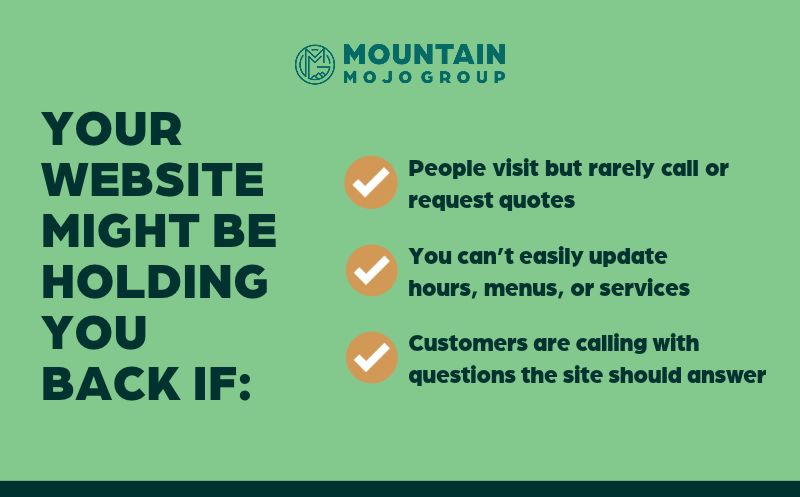
Sometimes the answer is yes. Your website may be what’s holding you back if people visit but rarely call or request a quote, if you can’t easily update hours, menus, or services yourself, or if customers keep calling to ask questions the site should already answer.
Other times, a new site won’t fix the real problem. If very few people are finding you in the first place, a redesign alone won’t change that, and the budget may do more good on local SEO, your Google Business Profile, or advertising first. If inquiries come in but nobody follows up quickly, that’s a process fix, not a website fix.
The point is to spend on the step where customers are actually dropping off.
Match what you’re seeing to where you start
Here are three situations local businesses often run into, along with one place to start and one thing to measure for each.
| What you’re seeing | Where to start | What to measure |
|---|---|---|
| A Flagstaff restaurant wants more weekday diners during a slower stretch. | Update hours and menus, then test a local weekday promotion. | Weekday reservations or offer redemptions. |
| A local service business gets website visits but few quote requests. | Test the mobile quote form and make service areas and contact options easy to find. | Completed quote requests and booked estimates. |
| A shop sees strong holiday sales but has little follow-up with shoppers. | Collect opt-in emails at checkout and test a January campaign. | Repeat purchases or campaign redemptions. |
For the shop in that last row, our guide to holiday marketing for local businesses has more ideas for turning holiday shoppers into regulars. And notice that none of these start with “spend more on ads.” Each one fixes the experience first and gives you a number to watch, so you’ll know by spring whether it worked.
Build your Q1 plan
You don’t need a 12-month plan finished by January. You need a clear first quarter. Changes you make in January have time to show results before spring, and what you learn shapes the rest of the year.
Choose three things:
- One thing to keep. Something that’s clearly bringing in customers, like a promotion people redeem or a listing that drives calls.
- One thing to fix. The spot where customers get stuck, based on what you found above.
- One thing to test. A new idea with a small budget and a clear measure.
Give each one a budget, an owner, and a review date on the calendar. Then fill in the worksheet below and keep it somewhere you’ll see it:
Worksheet
My 2027 Q1 marketing plan
Print this page or copy it into a doc, then fill in each line.
1. My one business goal for Q1
2. My three moves
Keep
Something that’s clearly bringing in customers.
Fix
The spot where customers get stuck.
Test
A new idea with a small budget and a clear measure.
3. When I’ll check results
Planning a new website or a refresh for 2027?
If your website made the “fix” list, we’d love to help. Tell us where customers get stuck today and what you want the site to help them do, whether that’s booking more estimates, filling weekday tables, or bringing shoppers back. Our Flagstaff-based team plans every site around the actions you want customers to take.
Explore Mountain Mojo’s website services
Prefer to talk it through first? Pick a time below for a free, no-pressure strategy call.

Who's Rand?
Rand’s journey started in restaurants, then took a sharp turn into MTV production in 2003, leading to 1,400+ concerts, festivals, and fundraisers. He co-founded Flagstaff’s Green Room venue, operated major outdoor events at the Pepsi Amphitheater, and ran three festivals before two successful exits led him to launch Mountain Mojo with partner Austin Leggett in 2015. Off the clock, he’s big on service, mentoring, and – most importantly – family time.
Small business marketing budget FAQs
How much should a small business spend on marketing?
There’s no single right number for every business. Start with the outcome you want and what a new customer is worth to you, then fund the step where customers drop off. Review results each quarter and adjust from there.
How do I know if my website needs a refresh?
Test it on your phone. If it’s hard to confirm your hours, understand what you offer, or call, book, or request a quote quickly, it’s worth a closer look. Lots of visits with few inquiries is another common sign.
What should I measure in my marketing budget?
Measure the customer action closest to your goal, like booked estimates, reservations, quote requests, or repeat purchases. Pick one or two numbers and compare them to the same months last year.
Never Miss a Thing.
Need more Mojo in your life? Sign up for our monthly newsletter! Get the inside scoop on Mojie life, client highlights, website projects, new Mojo clients, marketing tips & tricks, and so much more! Your inbox could use more Mojo!