
Hardware Marketing Series · Part 3 of 16

Once your organizational goals and revenue goals are defined, the next question becomes obvious: where is growth actually available in your market?
That’s where market share and competitive analysis come in.
Many hardware stores operate on assumptions about who their competitors are, where customers shop and why some stores perform better than others. But assumptions don’t lead to confident marketing decisions.
At Mountain Mojo Group, we see the biggest breakthroughs when stores take time to understand their local market. A solid market share and competitive analysis shows where you’re winning, where you’re losing and where the biggest growth opportunities are. Here’s how to do one without overcomplicating it.
This guide is Part 3 of our 16-part hardware marketing series. Each article walks through one step in building a connected marketing strategy for independent hardware stores and lumberyards, from organizational clarity to a complete marketing system built for long-term growth.
Free template · Step 3 of 16
Market Share & Competitive Analysis Template
This template helps you:
- Identify your true competitors
- Estimate market share
- Analyze competitor strengths and weaknesses
- Highlight opportunities for growth
Why Market Share and Competitive Analysis Matter
Marketing works best when it’s informed by reality, not guesswork. Without a clear picture of your market, you may be:
- Competing in overcrowded channels
- Underestimating (or overestimating) competitors
- Missing opportunities right in front of you
A market share and competitive analysis helps answer questions like:
- Who are our true competitors locally?
- Where are customers choosing us, and where are they going elsewhere?
- What do competitors do better, worse or differently?
- Where do we have room to grow?
This isn’t about copying competitors. It’s about understanding the playing field so your marketing can be intentional and differentiated. When we work with hardware stores and lumberyards, this step often unlocks clarity on positioning, messaging and channel priorities.

Step 1: Define Your True Competitive Set
Your competitors aren’t just other independent hardware stores or lumberyards. A realistic competitive set may include:
- Other independent hardware stores
- Big-box retailers
- Lumberyards
- Specialty retailers
- Online options
Start by listing the competitors customers would realistically choose instead of your store. Then narrow the list to:
- Primary competitors (most overlap)
- Secondary competitors (situational overlap)
This keeps your focus from spreading too thin and your analysis relevant.
Step 2: Estimate Local Market Size and Share
Market share doesn’t have to be precise to be useful. Start by estimating:
- Your total local market size (your geographic trade area)
- The approximate number of potential customers
- Total spend in key categories, when possible
Then look at your current revenue, department-level performance and your contractor, pro and retail sales breakdown. Together, these give you a directional sense of how much of the market you capture today and how much opportunity remains.
Even rough estimates provide valuable insight and help prioritize where marketing should focus.
Step 3: Analyze Competitor Strengths and Weaknesses
Next, evaluate how competitors show up in the market. Look at:
- Store experience and merchandising
- Product selection and pricing
- Online presence (website, Google Business Profile, reviews)
- Marketing visibility (ads, social, email)
- Community involvement and reputation
The goal isn’t to critique; it’s to spot patterns. Ask:
- Where are competitors clearly strong?
- Where do they fall short?
- What do customers seem to value most?
This often reveals gaps your store can fill with the right marketing strategy. Need help interpreting what you find? Book a discovery call with Rand.
Step 4: Identify Your Differentiators
Once you’ve analyzed competitors, turn the focus inward. Ask:
- What do we do better than competitors?
- What do customers consistently praise?
- What makes our store different or more valuable?
Differentiators may include customer service, pro expertise, product availability, community involvement, or convenience and speed.
Your marketing should amplify these differentiators, not try to compete on everything. At Mojo, we help hardware stores clarify and communicate what sets them apart so their marketing feels authentic and effective.
Step 5: Use Insights to Guide Marketing Priorities
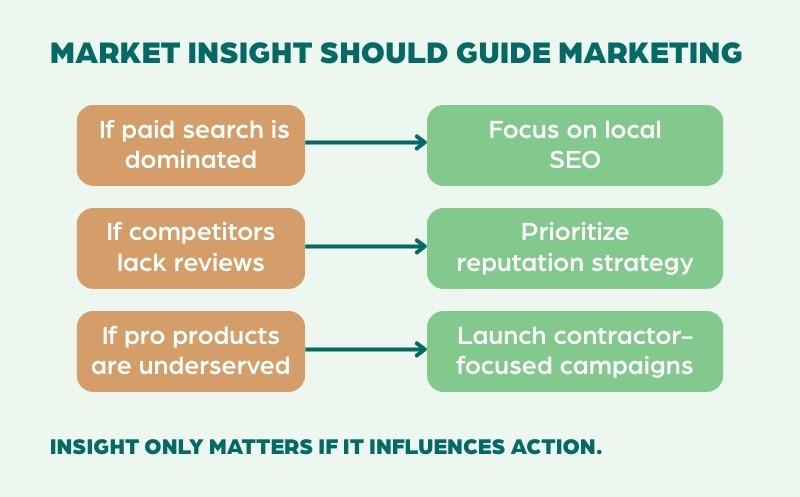
Market share and competitive insights should directly shape your marketing decisions. This is where analysis turns into action. Instead of competing everywhere, focus on the areas with the most opportunity. For example:
- If competitors dominate paid search, organic visibility or local marketing may offer a better return.
- If reviews are a weakness for competitors, reputation and review generation may be a priority.
- If certain departments or customer segments are underserved, targeted campaigns may perform well.
What This Looks Like in Practice
Imagine a local hardware store reviewing its competitive analysis.
It notices that big-box competitors dominate paid search for high-volume items. Instead of trying to outspend them, the store shifts its focus to local SEO, Google Business Profile updates and community-driven content.
It also sees that nearby competitors have inconsistent reviews. That leads to a renewed focus on review requests, response management and in-store reminders tied to great customer service moments.
Finally, the analysis shows that contractor-focused products are underserved in the area. Marketing shifts toward pro-focused messaging, email and in-store signage that supports those customers.
Turning Insights Into Focus
Once you’ve identified opportunities, prioritize them. Ask:
- Which opportunities align most closely with our organizational and revenue goals?
- Which can we realistically support with our current budget and capacity?
- Where can marketing make the biggest impact without spreading effort too thin?
Competitive insights also tell you what not to pursue. Not every channel or tactic is worth the investment. Many owners find that conversations with other independent hardware retailers help validate their findings and surface opportunities they wouldn’t see on their own.
When market insights guide marketing priorities, decisions get clearer, effort gets more focused and marketing supports real opportunities instead of noise.
Quick Action Steps for Hardware Store and Lumberyard Owners
Want to start analyzing your local market today? Begin here:
- List your true competitors. Include independent hardware stores, lumberyards, big-box retailers and online options customers may consider.
- Review their online presence. Look at competitor websites, Google Business Profiles and customer reviews to see how they present themselves.
- Identify strengths and weaknesses. Note where competitors excel and where they fall short on service, product availability, reputation or store experience.
- Clarify your differentiators. Decide what your store does better or differently than others in your market.
- Align marketing with opportunity. Focus on areas where you have an advantage or where competitors leave gaps.
Download the Market Share & Competitive Analysis Template
To help you apply this process, we’ve created a free Market Share & Competitive Analysis Template built specifically for hardware stores and lumberyards. It builds directly on the Organizational Goals and Revenue Goals templates from earlier in the series.
Free template · Step 3 of 16
Market Share & Competitive Analysis Template
This template helps you:
- Identify your true competitors
- Estimate market share
- Analyze competitor strengths and weaknesses
- Highlight opportunities for growth
Compete With Clarity
Understanding your market and competitors takes the guesswork out of marketing. A thoughtful market share and competitive analysis helps hardware stores and lumberyards focus on real opportunities, sharpen their differentiation and make smarter decisions based on how customers actually shop.
This isn’t about chasing competitors. It’s about understanding where your business fits in the local market, where you’re strongest and where growth is realistically available. It’s the same framework we use at Mountain Mojo Group to help independent hardware retailers and lumberyards grow with confidence.
In the next guide, we’ll cover how to create customer surveys that gather insights directly from your customers, so your strategy is built on real feedback, not assumptions.
Want help applying this to your store?
A short discovery call can help you walk through this analysis and turn insights into focused marketing priorities.
The Hardware Marketing Series
This article is part of our complete marketing strategy framework for independent hardware stores, lumberyards, farm stores and ag stores, including retailers affiliated with Ace Hardware, True Value and Do it Best, and suppliers such as Orgill. Work through all 16 steps to build your strategy in a structured, intentional way. See the full series.
- How to Create Organizational Goals for Your Hardware Store
- How to Create Revenue Goals
- How to Perform a Market Share & Competitive Analysis (you’re here)
- How to Create Customer Surveys
- How to Define Mission, Vision & Core Values
- How to Audit Your Branding
- How to Create Target Personas with Shopping Behaviors
- How to Audit Social Media, Google Ads & SEO
- How to Build & Maintain Your Google Business Profile
- How to Build a Social Media Plan
- How to Build an SEO Strategy
- How to Build Social Media & Google Ads Campaigns
- How to Build an Email Newsletter
- How to Build a Content Calendar
- How to Build a Marketing Budget
- How to Build a Holistic Marketing Strategy