
Hardware Marketing Series · Part 2 of 16
Once your organizational goals are clear, the next step is turning that direction into numbers. This is where many hardware stores get stuck.
Revenue goals often feel intimidating, unrealistic or disconnected from day-to-day operations. Some stores rely on last year’s numbers and hope for the best. Others set aggressive targets without a plan to support them.
At Mountain Mojo Group, we see the most success when revenue goals are grounded in reality, aligned with organizational priorities and used to guide marketing decisions, not pressure them. Here’s how to create revenue goals for your hardware store or lumberyard that are achievable, measurable and useful for planning your marketing budget and tactics.
This guide is Part 2 of our 16-part hardware marketing series. Each article walks through one step in building a connected marketing strategy for independent hardware stores and lumberyards, from organizational clarity to a complete marketing system built for long-term growth.
Free template · Step 2 of 16
Revenue Goals Template
This template helps you:
- Set realistic revenue targets
- Break goals into manageable timeframes
- Align revenue goals with organizational priorities
- Use revenue goals to guide marketing decisions
Why Revenue Goals Matter for Hardware Stores and Lumberyards
Revenue goals give your marketing strategy something concrete to support.
Without revenue goals:
- Marketing budgets feel arbitrary
- It’s hard to prioritize channels
- Success becomes subjective
With clear revenue goals:
- Marketing spend can be planned intentionally
- Expectations are clearer across the business
- Performance can be measured more accurately
Revenue goals connect organizational priorities, like growing contractor accounts or increasing foot traffic, to measurable financial outcomes.
We don’t believe in setting revenue goals just to hit a number. They should guide where time, effort and budget go, and make it easier to see what’s working and where to adjust.
Start With Your Organizational Goals
Revenue goals should always be built on top of your organizational goals, not created in isolation. For example:
- If your goal is to grow pro accounts, revenue goals should reflect projected pro sales growth.
- If your goal is to increase foot traffic, revenue goals may focus on average transaction value or repeat visits.
- If a department or product line is the priority, such as lumber, materials, rentals or services, break revenue goals down to match.
This alignment keeps marketing focused on the right outcomes and stops you from chasing revenue in areas that don’t fit your broader priorities.
If your organizational priorities aren’t clear yet, start with Part 1: How to Create Organizational Goals for Your Hardware Store.
Use Historical Data as a Baseline
The most realistic revenue goals start with historical performance. Look at:
- Total revenue from the past 12–24 months
- Seasonal trends tied to building cycles, weather and project demand
- Department or product line performance, including lumber, materials and services
- Your pro, contractor and retail sales breakdown
This data gives you context and helps you avoid goals that are either too conservative or unrealistically aggressive. For example:
- If your store typically grows 3–5% a year, a sudden 20% jump may require significant operational or marketing changes.
- If revenue spikes during peak build seasons, annual goals should account for that timing.
- If contractor sales drive most of your volume, growth may come more easily from account growth and project size than from foot traffic.
Using historical data doesn’t limit growth. It gives you a realistic starting point.
Break Revenue Goals Into Manageable Pieces
Large revenue goals feel overwhelming when they aren’t broken down. Instead of one annual number, consider:
- Quarterly revenue targets
- Department-level goals
- Separate pro, contractor and retail revenue goals
Smaller pieces are easier to track and easier for marketing to support.
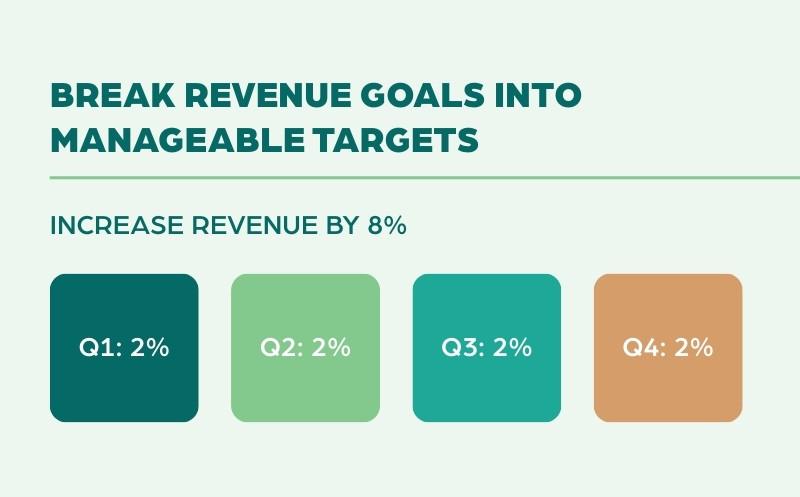
This approach also makes it easier to adjust your marketing throughout the year based on performance.
Mojo Note: Revenue goals aren’t meant to be set once and forgotten. Quarterly targets and benchmarks give you built-in moments to review progress, make adjustments and keep marketing aligned with current priorities. Small course corrections during the year work far better than big changes late in the game.
Many owners also find that conversations with other independent retailers bring useful perspective when evaluating revenue targets and marketing performance.
Align Revenue Goals With Marketing Capacity and Budget
Revenue goals should be ambitious, but realistic. Marketing can support growth only when the right investment and capacity are in place. Aggressive goals without the budget, staffing or operational readiness behind them usually lead to frustration instead of progress.
Before you lock in revenue targets, pressure-test a few basics:
- Do we have the budget to support this level of growth?
- Do we have the internal capacity to execute consistently?
- Are timelines realistic given seasonality and demand?
At Mountain Mojo Group, we help hardware stores and lumberyards align revenue goals with their marketing budget, available internal resources and realistic timelines. That keeps marketing sustainable and focused. Instead of chasing short-term spikes, teams can plan ahead and support growth intentionally.
When revenue goals match capacity, marketing becomes proactive. Decisions happen earlier, priorities are clearer and progress is easier to maintain.
Recommended Reading for Store Owners
If you want a framework for setting and executing business goals, read Traction by Gino Wickman. It introduces practical systems for setting measurable goals, tracking progress and keeping teams aligned around clear priorities, which many independent retailers use to turn long-term ideas into actionable plans.
What Revenue Goals Look Like in Practice
Here are two scenarios we see often with hardware stores and lumberyards.
Scenario 1: Revenue Goals Without Structure
A store sets a goal to grow revenue 15% this year. The number sounds good, but there’s no breakdown by quarter, department or customer type. Marketing runs a mix of ads, promotions and emails throughout the year, with no clear connection to the target.
By midyear, results feel inconsistent. Some months perform well, others fall short. It’s hard to tell what’s working, what needs adjusting or whether the goal is still realistic. Marketing feels busy, but direction is unclear.
Scenario 2: Revenue Goals With Alignment
Another store starts by reviewing historical performance and seasonality. It breaks an 8% annual growth goal into quarterly targets, with separate goals for retail and contractor sales. Marketing is planned around those targets, with a specific focus for each quarter.
When Q1 comes in slightly under target, the store adjusts early: budget shifts and messaging is refined. By the end of Q2, performance is back on pace.
Here, revenue goals act as a guide instead of a scoreboard. Marketing decisions tie to clear priorities, progress is easy to track and adjustments feel intentional instead of reactive.
Why This Difference Matters
The difference isn’t effort. It’s structure. When revenue goals are clear, measurable and aligned with capacity, marketing is easier to manage and growth is easier to sustain.
Quick Action Steps for Hardware Store and Lumberyard Owners
Want to start applying this today? Begin here:
- Review your historical revenue data. Look at the past 12–24 months, including seasonal trends and department-level performance.
- Identify growth opportunities. Decide whether growth will come from contractor accounts, more foot traffic, department expansion or larger average transactions.
- Set a realistic annual revenue target. Use historical performance as the baseline for a realistic growth percentage.
- Break the goal into quarters. Quarterly targets make it easier to track progress and adjust marketing during the year.
- Align marketing with revenue targets. Campaigns, promotions and messaging should support the growth areas you’ve identified.
Download the Revenue Goals Template
To help you put this into action, we’ve created a free Revenue Goals Template built specifically for hardware stores and lumberyards. It builds directly on the Organizational Goals Template from Part 1.
Free template · Step 2 of 16
Revenue Goals Template
This template helps you:
- Set realistic revenue targets
- Break goals into manageable timeframes
- Align revenue goals with organizational priorities
- Use revenue goals to guide marketing decisions
Turning Direction Into Numbers
Revenue goals turn organizational direction into measurable outcomes. When they’re clear, marketing decisions get easier, budgets become more intentional and progress is easier to track. It’s the approach we use at Mountain Mojo Group to help hardware stores and lumberyards grow with clarity and confidence.
In the next guide, we’ll cover how to perform a market share and competitive analysis, which shows where growth opportunities actually exist in your market.
Want help applying this to your store?
A short discovery call can help you align revenue goals with a marketing strategy built for your store.
The Hardware Marketing Series
This article is part of our complete marketing strategy framework for independent hardware stores, lumberyards, farm stores and ag stores, including retailers affiliated with Ace Hardware, True Value and Do it Best, and suppliers such as Orgill. Work through all 16 steps to build your strategy in a structured, intentional way. See the full series.
- How to Create Organizational Goals for Your Hardware Store
- How to Create Revenue Goals (you’re here)
- How to Perform a Market Share & Competitive Analysis
- How to Create Customer Surveys
- How to Define Mission, Vision & Core Values
- How to Audit Your Branding
- How to Create Target Personas with Shopping Behaviors
- How to Audit Social Media, Google Ads & SEO
- How to Build & Maintain Your Google Business Profile
- How to Build a Social Media Plan
- How to Build an SEO Strategy
- How to Build Social Media & Google Ads Campaigns
- How to Build an Email Newsletter
- How to Build a Content Calendar
- How to Build a Marketing Budget
- How to Build a Holistic Marketing Strategy