
Hardware Marketing Series · Part 11 of 16

A strong SEO strategy answers one key question: how do customers actually find our store, services and products online?
Done well, SEO supports foot traffic, phone calls and long-term visibility. It doesn’t require constant changes or complex tactics. It requires consistency and alignment with real search behavior.
At Mountain Mojo Group, we treat SEO as a foundational channel that supports the broader marketing system. Here’s how to build an SEO strategy that’s realistic, sustainable and focused on local demand, while staying aligned with your organizational goals.
This guide is Part 11 of our 16-part hardware marketing series. Each article walks through one step in building a connected marketing strategy for independent hardware stores and lumberyards, from organizational clarity to a complete marketing system built for long-term growth.
Free guide · Step 11 of 16
SEO Strategy Guide
This guide helps you:
- Define a clear SEO goal
- Identify priority pages
- Map search themes to your services
- Track performance over time
Why SEO Matters for Hardware Stores and Lumberyards
SEO helps your store show up when customers are actively looking, whether they’re searching for products, services, store locations or local solutions. It supports store visits, phone calls, direction requests and long-term visibility. And it works over time: results compound.
Step 1: Set Clear SEO Goals for Your Hardware Store
SEO needs a job. Choose one primary goal to start, tied to your broader organizational priorities and a clear timeline. Strong SEO goals might look like:
- Increase organic traffic to key service pages by 20% over the next six months.
- Generate 15 additional phone calls per month from local search.
- Improve visibility for priority departments during the next peak season.
- Drive more contractor-related search traffic that leads to consistent quote requests each quarter.
Avoid vague or open-ended goals. If you can’t measure progress or set a timeframe, the goal won’t guide decisions.
Mojo Note: SEO goals should always tie back to your organizational goals. If growth, services or contractor relationships are a priority, your SEO goals should reflect that, with a clear timeframe for review.
Step 2: Identify Keywords That Actually Matter
Keyword research for hardware stores isn’t about clever words. It’s about the specific phrases DIYers and contractors use mid-project.
Start With Real-World Data
- Department keywords: Go beyond “hardware store.” Focus on terms like lumberyard, power tools or outdoor living.
- Service keywords: Use high-intent terms like key cutting, propane refills or glass repair.
- The contractor factor: Target pro accounts with terms like bulk lumber pricing or commercial-grade fasteners.
Confirm Demand With Google Tools
- Google Business Profile insights: Check the search queries report to see exactly how locals found you last month.
- Google Search Console: Find “low-hanging fruit” — pages getting views that need a boost to reach page one.
- Google Autocomplete: Type “[service] + [your city]” into Google to see the most common real-time variations.
Focus on real inventory, local intent (your city name) and actual search behavior.
Mojo Insight: If you’re struggling to sift through the noise and want to know exactly which terms will move the needle for your store, book a discovery call with Rand. We’ll help you find the data-driven keywords your store should focus on.
Step 3: Build SEO Around Key Website Pages
SEO works best when it’s tied to specific, dedicated pages. Your website should mirror your physical store layout. Don’t bury your services on one generic page.
The “Priority Four” Page Types
- Location pages: Essential for multi-store brands to rank for “[city] hardware store.”
- Service pages: Target high-intent searches like key cutting or pipe threading.
- Department pages: Digital aisles for hardwood lumber, power tools and more.
- Seasonal pages: Capture trending traffic like winter prep or spring landscaping.
The Anatomy of a High-Ranking Page
For Google to see these pages as valuable, each one should follow four rules:
- One topic: Don’t mix lawnmowers with lumber; it confuses search engines.
- Match intent: If someone searches “delivery,” show delivery zones and pricing right away.
- Answer FAQs: Questions like “Do you deliver on Saturdays?” help you rank for voice search.
- Clear call-to-action: Tell visitors to call for a quote or check in-stock inventory.
Your homepage is a digital business card, but your internal pages are your digital sales team. Never rely on the homepage alone. You can see this structure on hardware store websites like Colorado Ace Hardware and Timberline Ace, where services, departments and seasonal topics each have their own dedicated pages.
Step 4: Use SEO Content to Support Your Core Pages
Blogs and articles play an important role in SEO, but they don’t replace service or category pages. They extend and reinforce them by:
- Capturing longer, more specific search terms customers use when researching projects
- Answering common questions that don’t fit neatly on a service page
- Supporting seasonal topics or temporary demand
- Reinforcing the relevance of priority services and departments
This helps search engines understand what your store offers and how your pages connect. Blogs are most useful when customers need more context before visiting, or when a topic supports a core service without replacing it.
Content that works well for hardware stores and lumberyards includes project guides for materials or tools you sell, seasonal prep articles tied to local demand, service explanations that answer common questions, and buying guides that help customers plan before visiting.
Quality matters more than volume. One intentional article that supports a priority page beats frequent posts without a clear purpose.
Step 5: Cover the Technical SEO Basics
Strong SEO needs a solid foundation. Confirm that:
- Page titles are clear and descriptive
- Meta descriptions explain value
- Headings are structured logically
- Pages load quickly
- The mobile experience works well
If the basics are broken, SEO performance stalls. Not sure whether yours are working? A technical SEO and website audit can identify gaps in page structure and on-page SEO, site speed and mobile usability, and technical issues that limit visibility. If you’d like help reviewing your site, book a discovery call with Rand.
Track SEO Performance That Actually Matters
SEO should be measurable. Focus on traffic from search, calls and direction requests, your top-performing pages and the search terms driving visits. Avoid relying on vanity metrics alone: traffic only matters if it supports real business outcomes.
What an SEO Strategy Looks Like in Practice
Without structure, you get random blog topics, missing service pages and hard-to-measure results.
With structure, pages are built around real searches, content supports priority services and performance is easier to track. SEO becomes a system, not a guessing game.
Quick Action Steps for Hardware Store and Lumberyard Owners
Want to improve your store’s SEO visibility? Begin here:
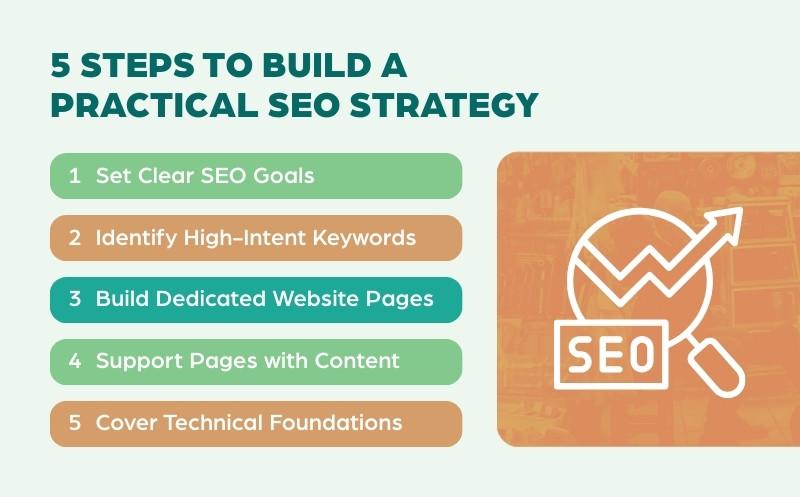
- Define your SEO goal. Choose one measurable outcome, like more service page traffic or more local phone calls.
- Identify priority keywords. Focus on real customer searches tied to your services, departments and location.
- Build dedicated pages. Create individual pages for services, departments and locations so Google understands what you offer.
- Publish supporting content. Use articles and guides to answer common questions and reinforce your core pages.
- Track search performance. Review traffic, calls and search queries regularly to see what’s improving.
SEO improves most when small improvements happen consistently over time.
Download the SEO Strategy Guide
To help you organize all of this into a clear plan, we’ve created a free SEO Strategy Guide built specifically for hardware stores and lumberyards. It walks you through nine steps, from your SEO goal and priority pages to tracking and a review schedule.
Free guide · Step 11 of 16
SEO Strategy Guide
This guide helps you:
- Define a clear SEO goal
- Identify priority pages
- Map search themes to your services
- Track performance over time
Build SEO for Long-Term Growth
SEO isn’t about quick wins. It’s about building visibility that lasts. When your SEO strategy reflects how customers search and how your store operates, it becomes one of the most reliable drivers of long-term growth.
In the next guide, we’ll cover how to build social media and Google Ads campaigns that put your plan into action.
Want help applying this to your store?
A short discovery call can help you build or refine an SEO strategy for your hardware store or lumberyard.
The Hardware Marketing Series
This article is part of our complete marketing strategy framework for independent hardware stores, lumberyards, farm stores and ag stores, including retailers affiliated with Ace Hardware, True Value and Do it Best, and suppliers such as Orgill. Work through all 16 steps to build your strategy in a structured, intentional way. See the full series.
- How to Create Organizational Goals for Your Hardware Store
- How to Create Revenue Goals
- How to Perform a Market Share & Competitive Analysis
- How to Create Customer Surveys
- How to Define Mission, Vision & Core Values
- How to Audit Your Branding
- How to Create Target Personas with Shopping Behaviors
- How to Audit Social Media, Google Ads & SEO
- How to Build & Maintain Your Google Business Profile
- How to Build a Social Media Plan
- How to Build an SEO Strategy (you’re here)
- How to Build Social Media & Google Ads Campaigns
- How to Build an Email Newsletter
- How to Build a Content Calendar
- How to Build a Marketing Budget
- How to Build a Holistic Marketing Strategy